Why Doesn't Light Just Leak Out the Sides of the Fiber?
How Does Light Stay Trapped Inside a Hair-Thin Strand of Glass?
It sounds like science fiction: a beam of light entering a fragile thread of glass and traveling hundreds of kilometers without escaping. No mirrors, no power, no shielding—just pure geometry and physics. Yet this is the everyday reality of optical fiber. So how, exactly, does light remain confined in something so small and seemingly simple?
The answer reveals one of the most elegant applications of classical optics in modern engineering.
Why Doesn't Light Just Leak Out the Sides of the Fiber?
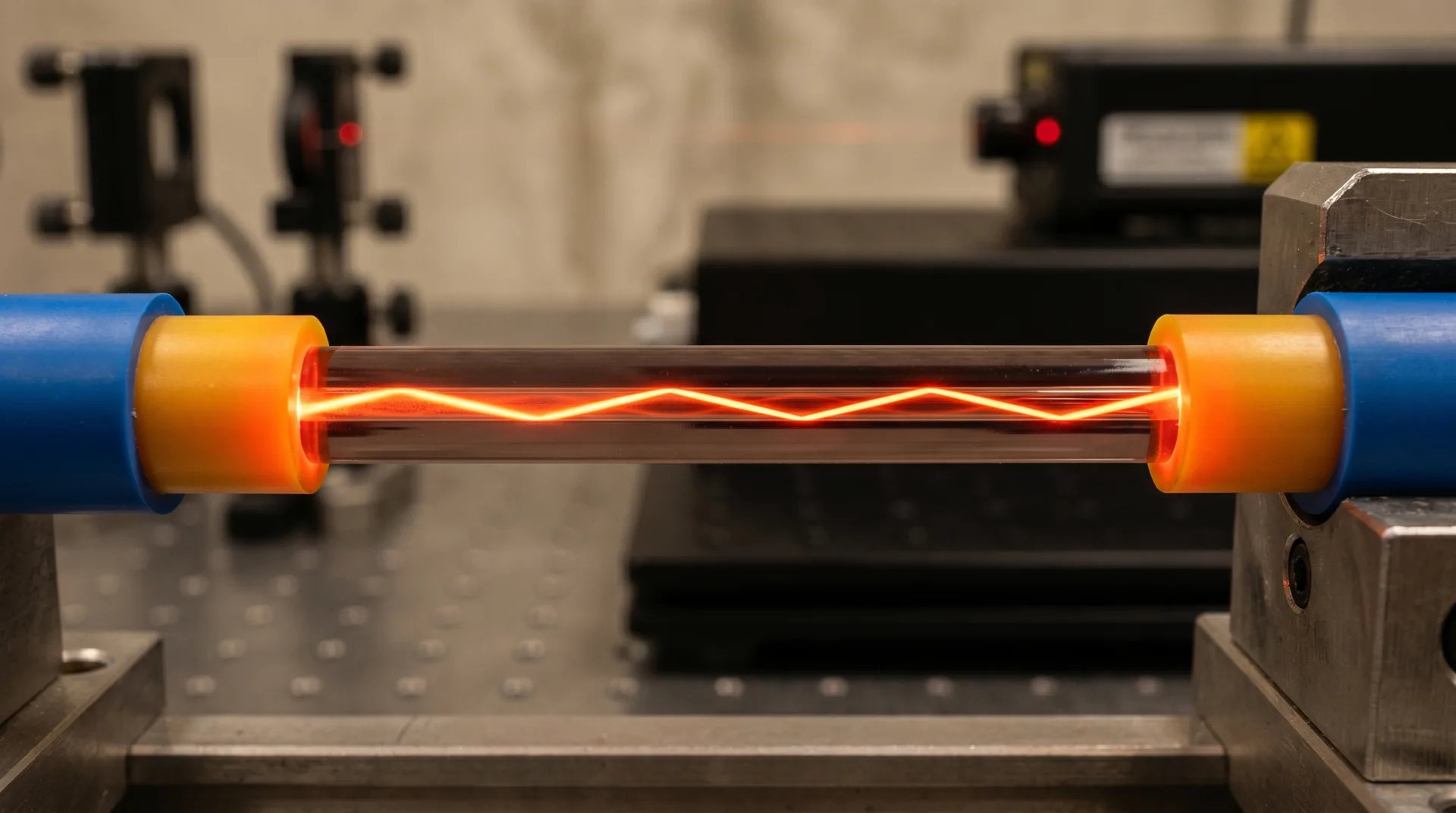
Because the fiber isn’t just a tube of glass—it’s a precision optical waveguide designed to exploit a fundamental law of light: total internal reflection.
When light travels from a material with a higher refractive index into one with a lower index—like from water into air—it bends away from the normal. Tilt the interface enough, and the light no longer exits at all. Instead, it reflects entirely back into the original material. This is total internal reflection, and it’s the same phenomenon that makes underwater objects appear mirrored when viewed from below at a steep angle.
In fiber optics, this principle is engineered at the molecular level. The core—the central region where light travels—is made of silica glass slightly doped with germanium dioxide, raising its refractive index to about 1.468. Surrounding it is the cladding, made of pure silica with a lower index of about 1.457. That tiny difference—less than 1%—is enough to create an invisible, lossless boundary. For a broader look at the full “stay and travel” story—confinement plus long-distance preservation—see our companion piece on what makes light stay in the fiber core.
As long as light strikes this core-cladding interface at a shallow enough angle (determined by the fiber’s numerical aperture), it reflects cleanly back into the core, over and over, like a runner staying perfectly centered in a curved hallway. No energy escapes. No signal bleeds out. The light is, for all practical purposes, trapped.
Isn't Glass Transparent? Shouldn't Light Pass Right Through the Walls?
This is a brilliant question—and it cuts to the heart of a common misconception. Yes, glass is transparent, but transparency doesn’t mean light passes through every boundary unimpeded. What matters isn’t just the material, but the interface between materials.
Imagine shining a flashlight through a glass window: most light passes through because the air-glass-air transitions are relatively gentle, and the surfaces are flat and parallel. But in an optical fiber, the core and cladding are not just different materials—they’re fused together in a way that creates a step change in refractive index. This step acts like an optical one-way valve for certain angles of light.
Photons traveling within the acceptance cone—the range of angles defined by the numerical aperture—are guided. Those outside it? They refract into the cladding and are quickly lost as heat or scattered noise. That’s why how you launch light into the fiber matters: too steep an angle, and your signal never makes it past the first few meters.
So while the glass is transparent, the structure is selective. The fiber doesn’t block light—it chooses which light to keep.
Does the Light Bounce Like a Pinball, or Flow Smoothly?
Both descriptions contain truth—but the deeper reality is wave-like, not particle-like.
In popular illustrations, light is often shown zigzagging down the fiber like a pinball. This ray model works well for understanding basic guidance in multimode fiber, where many light paths (or “modes”) coexist. But in single-mode fiber—the backbone of long-haul and high-speed networks—the core is so narrow (about 9 micrometers) that only one fundamental mode propagates.
Here, light doesn’t “bounce.” It exists as an electromagnetic wave whose electric and magnetic fields extend continuously through the core and slightly into the cladding as an evanescent field. This field decays exponentially with distance—meaning almost all the energy stays confined, even though the wave technically “touches” the cladding.
Think of it less like a ball in a pipe and more like a river flowing through a canyon: the water doesn’t hit the walls; it’s shaped by them. The fiber’s refractive index profile acts as the canyon walls, gently guiding the wave without disruption—so long as the geometry remains perfect.
What Happens If the Fiber Bends or Gets Stressed?
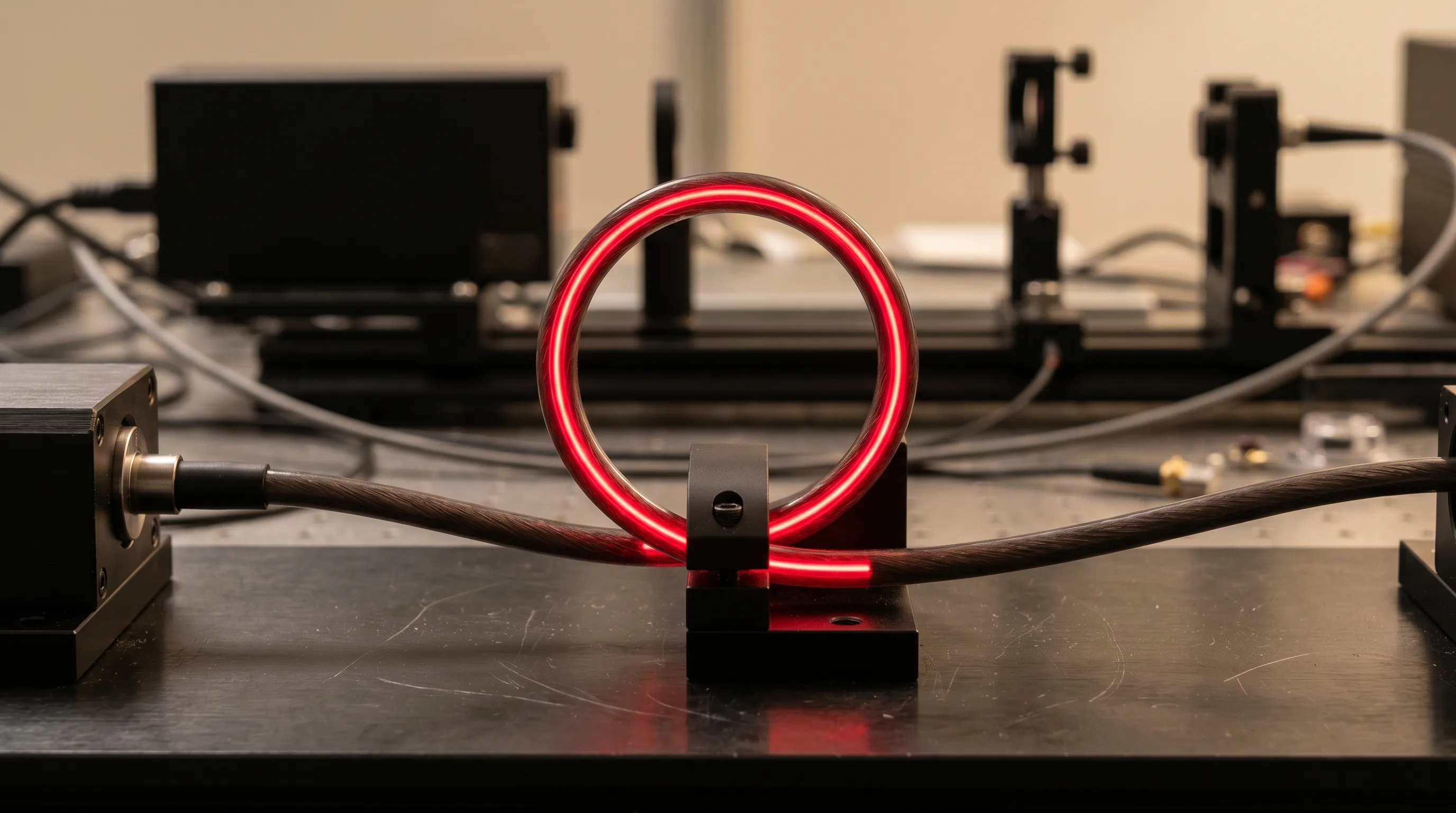
Even the best confinement has limits. Bend the fiber too sharply, and you break the conditions for total internal reflection.
At a tight bend, the angle at which light strikes the core-cladding boundary becomes too steep. Photons that once reflected cleanly now refract into the cladding and leak out—a phenomenon known as macrobending loss. This is why installers are trained to respect minimum bend radii (typically 30 mm for standard single-mode fiber during installation, 15 mm long-term). For a deeper treatment of what else can perturb the guided mode—from connector contamination to nonlinear effects—see can anything actually disrupt the light signal inside fiber.
More subtly, microbending—tiny deformations from pressure, crushing, or thermal stress—can scatter light out of the guided mode. These aren’t visible to the eye, but they degrade signal quality over time, especially in high-density cable trays or aerial deployments.
This fragility isn’t a flaw in the physics—it’s a reminder that confinement is conditional. The fiber’s ability to trap light depends entirely on maintaining its geometric and material integrity. Distort that, and even the most perfect waveguide begins to leak. External culprits like EMI, temperature swings and construction damage are surveyed in our guide on what can interfere with fiber optic internet.
So Is the Core Just a "Light Pipe," or Is There More to It?
Far more. The core isn’t a passive tunnel—it’s an engineered optical environment.
By precisely controlling the concentration of dopants like germanium or fluorine, manufacturers shape the refractive index profile. In step-index fiber, the core has a uniform index. In graded-index multimode fiber, the index gradually decreases from center to edge, causing light rays to follow curved paths that equalize travel time—reducing modal dispersion. This dopant-level control starts with the feedstock itself—see the raw materials of high-quality optical fiber glass for how purity and index control are achieved at the preform stage.
In advanced fibers like non-zero dispersion-shifted fiber (NZ-DSF) or large effective area fiber (LEAF), the core profile is tailored to manage nonlinear effects or chromatic dispersion in dense wavelength-division multiplexing (DWDM) systems.
In other words, the core doesn’t just guide light—it shapes its behavior to meet the demands of speed, distance, and capacity. It’s not a pipe. It’s a stage, and light is the performer choreographed by the laws of physics and the ingenuity of engineers.
Why Does This Quiet Confinement Matter?
Because in a world flooded with noise—electrical, radio, digital—the ability to guide light without interference is revolutionary. Total internal reflection gives us a channel so pure that a single fiber strand can carry the entire content of the Library of Congress in seconds.
And it does so not with brute force, but with elegance: a whisper of refractive index difference, a perfect cylinder of glass, and the timeless behavior of light itself.
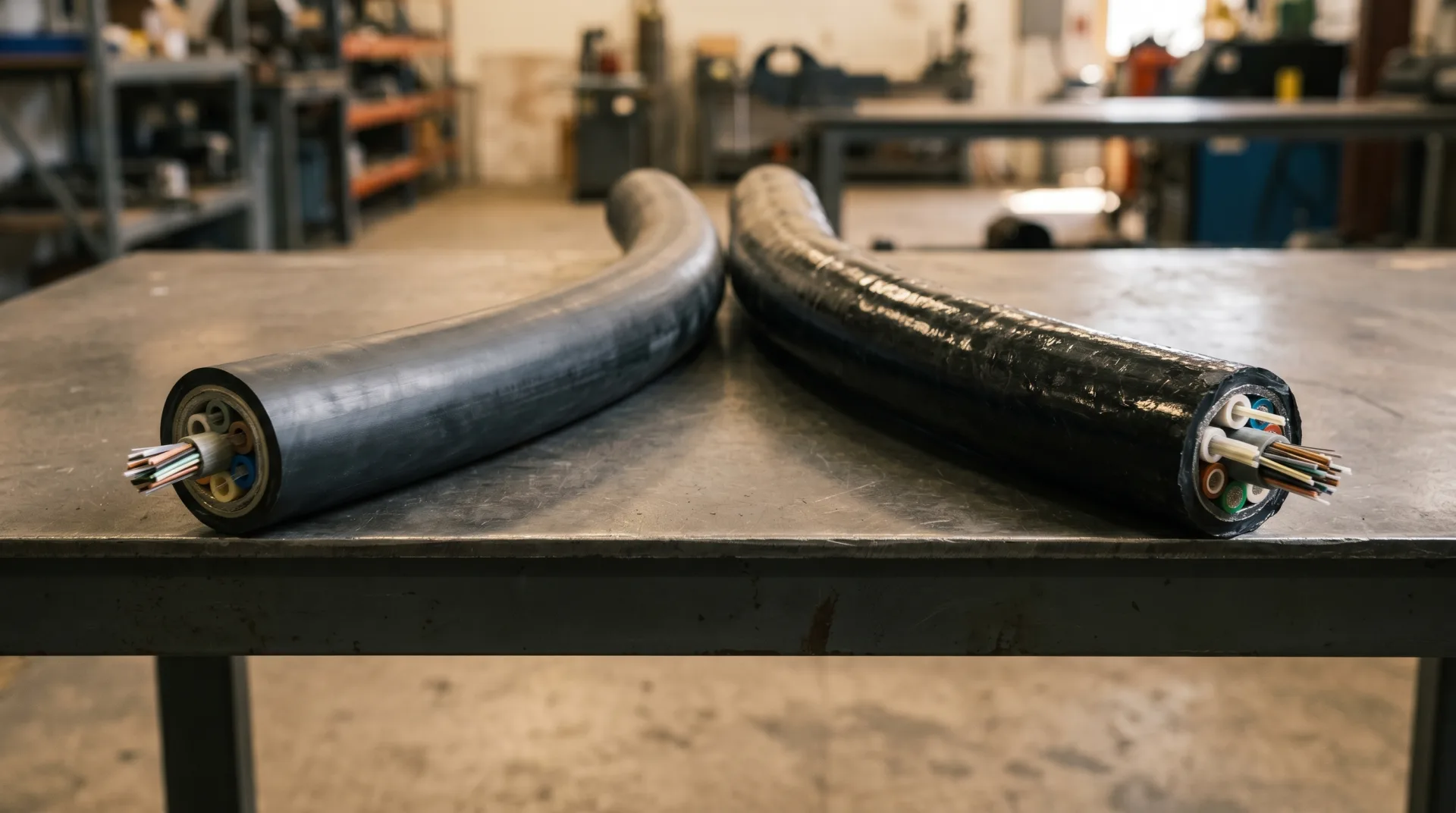
So the next time you stream a video, join a global call, or access cloud data, remember: somewhere beneath your feet or across an ocean, light is racing through a thread of glass—staying perfectly on course, not because it’s forced to, but because the path was designed with such care that it simply wants to stay. For finished cable assemblies engineered to protect this delicate geometry in the field, browse our range of outdoor fiber optic cable.