What Makes Light Stay in the Fiber Core
What Makes Light “Stay” in the Core—and Travel So Far Without Fading?
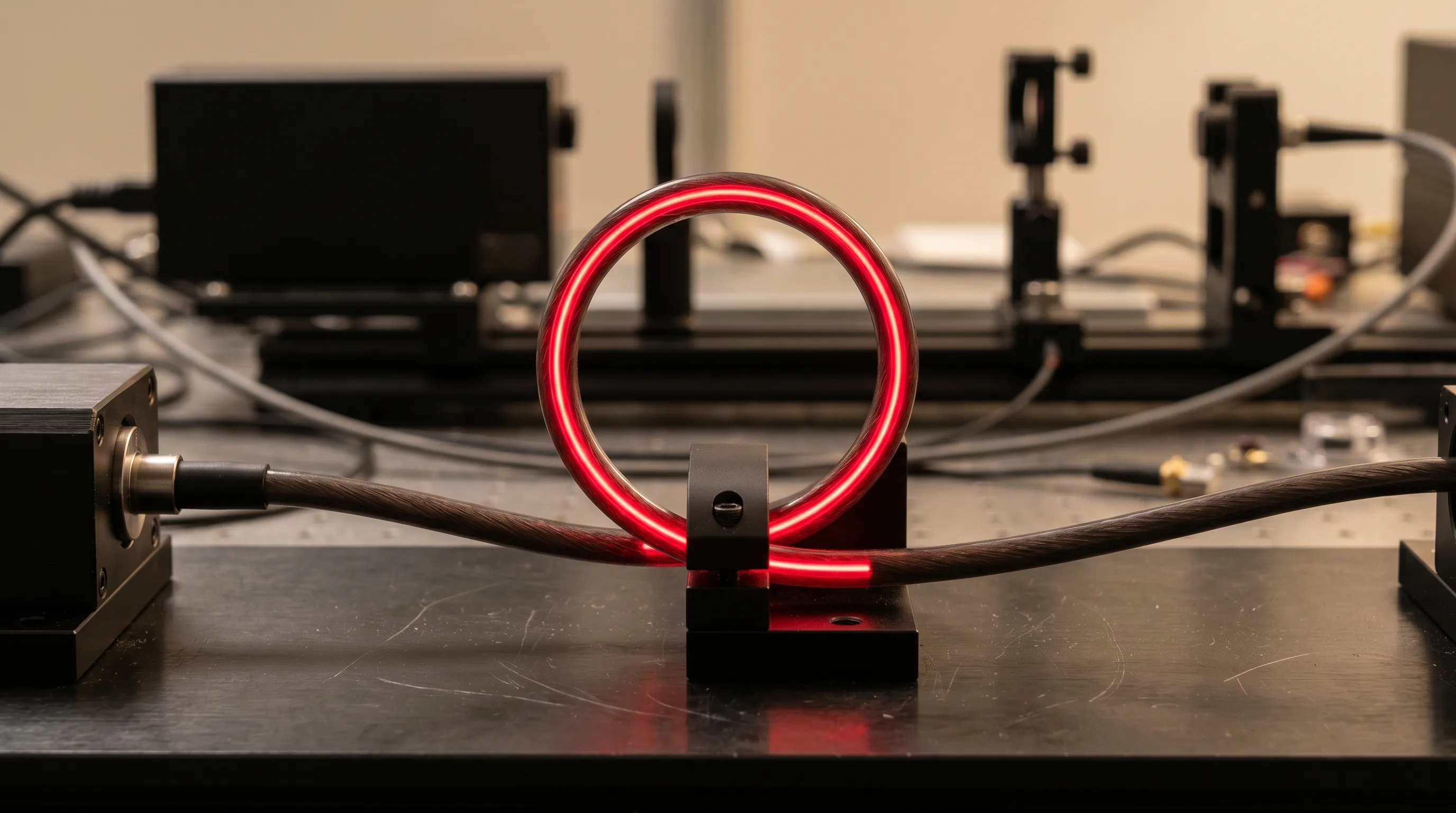
At the heart of every optical fiber lies a paradox: light, which naturally spreads and scatters in free space, is guided over hundreds of kilometers through a strand of glass thinner than a human hair—with astonishingly little loss. This isn’t magic. It’s the result of two intertwined scientific achievements: precise control of material purity and elegant manipulation of optical physics. Together, they enable light to remain confined within the fiber’s core and propagate with minimal attenuation, even across transoceanic distances.
But how, exactly, does light stay trapped? And why doesn’t it fade away like a signal in copper or radio waves in the atmosphere?
The answer unfolds in two acts: confinement and preservation. For a companion view of what can undo that confinement in the real world, see can anything actually disrupt the light signal inside the fiber.
Act I: Confinement — How Light Is Kept Inside the Core
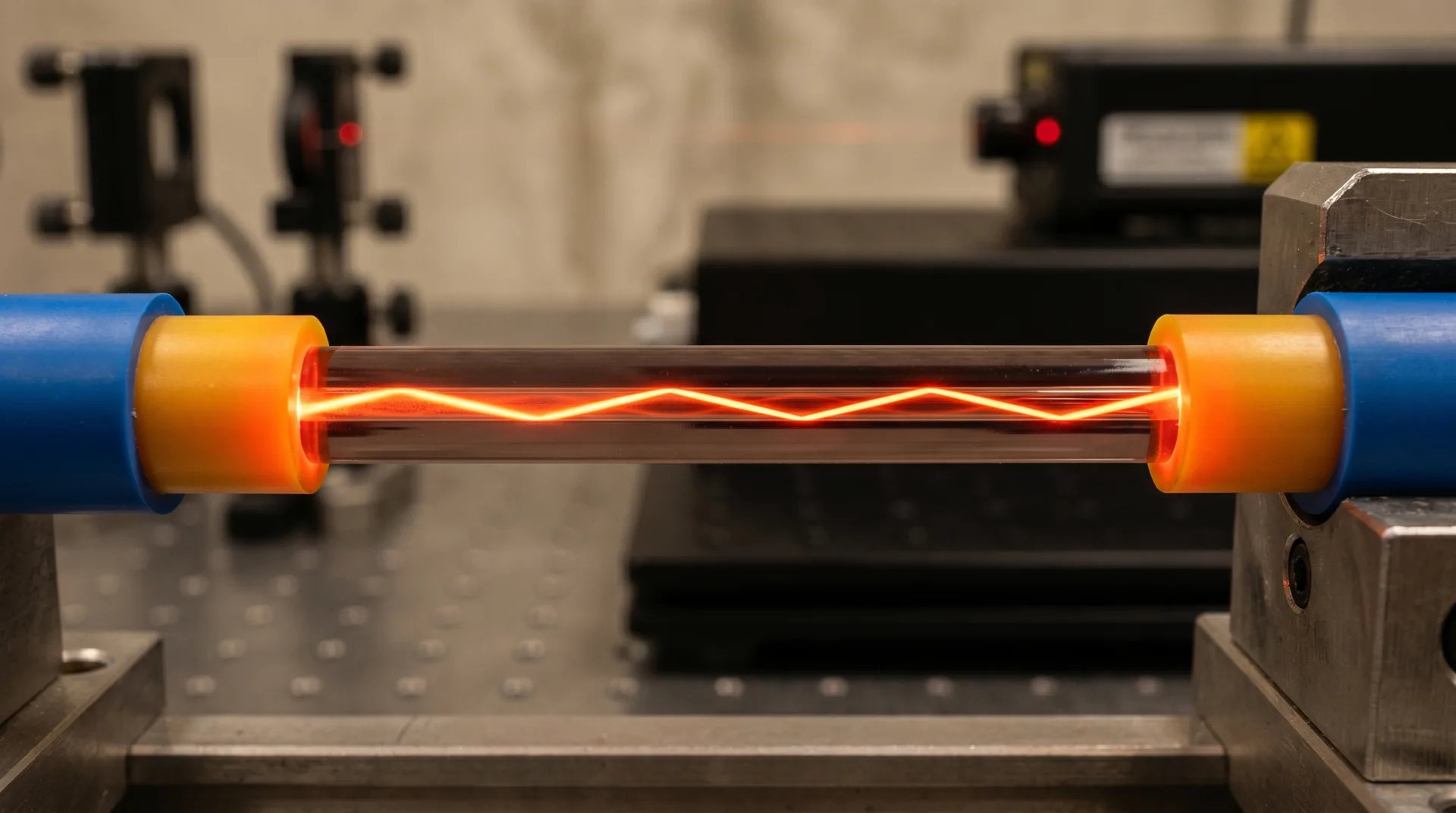
Light remains in the core due to a principle called total internal reflection (TIR)—a phenomenon that occurs when light traveling through a higher-refractive-index material strikes the boundary with a lower-index material at a shallow enough angle.
In optical fiber, this is engineered by creating a core-cladding structure:
- The core—typically made of silica doped with germanium dioxide (GeO2)—has a slightly higher refractive index (about 1.468).
- The cladding, made of pure silica, has a lower index (about 1.457).
This small difference—less than 1%—is enough to create an optical “wall.” When light enters the core within a specific acceptance angle (defined by the fiber’s numerical aperture), it reflects cleanly off the core-cladding interface, like a mirror that never tarnishes. No energy leaks out; the photon continues its journey, bouncing zigzag down the fiber.
This waveguide structure doesn’t just reflect light—it supports guided modes. In single-mode fiber (used in long-haul and high-speed networks), only one fundamental mode propagates, eliminating modal dispersion and enabling coherent transmission at 100G, 400G, and beyond. The mode isn’t confined to the very center; it extends slightly into the cladding as an evanescent field, but remains bound as long as the refractive index step is maintained.
Crucially, this confinement is passive and lossless in theory. Unlike electrical signals in copper, which lose energy to resistance and radiation, guided light in an ideal fiber would travel indefinitely—were it not for imperfections in the real world. For the full catalogue of those imperfections, see our guide on what can interfere with fiber optic internet.
Act II: Preservation — Why Light Doesn’t Fade Over Distance
Confinement keeps light in the fiber—but preservation ensures it doesn’t lose power. Here, the story shifts from geometry to materials science. Even the tiniest impurities or structural irregularities can absorb or scatter photons, turning signal into heat or noise.
Remarkably, modern telecom fiber achieves attenuation as low as 0.15 decibels per kilometer at 1550 nanometers. That means after 100 km, about 3% of the original light remains—enough for sensitive receivers to reconstruct the signal. To put this in perspective: if window glass had this level of clarity, you could see through a pane 20 kilometers thick.
This near-perfect transparency is possible because fiber manufacturers have pushed silica purity to extraordinary levels and engineered around fundamental physical limits. For the upstream story of how that purity is achieved, see our explainer on the raw materials of high-quality optical fiber glass. Three mechanisms dominate optical loss—and each has been systematically minimized:
1. Rayleigh Scattering — The Unavoidable Floor
Even in chemically perfect glass, light scatters due to microscopic density and compositional fluctuations frozen into the material during its transition from molten to solid state. These fluctuations are smaller than the wavelength of light, causing elastic scattering in all directions.
This Rayleigh scattering is intrinsic to all amorphous materials and scales inversely with the fourth power of wavelength (1/λ⁴). That’s why fiber loss is lower at longer wavelengths: 1550 nm (0.15–0.2 dB/km) is far more transparent than 850 nm (2–3 dB/km).
Critically, Rayleigh scattering sets the theoretical lower limit for silica fiber loss—about 0.14 dB/km at 1550 nm. Modern fibers operate within 0.01–0.03 dB/km of this limit. No further material refinement can beat it; it is a thermodynamic boundary.
2. Infrared and Ultraviolet Absorption — The Natural Edges
Silica isn’t transparent across all wavelengths. At very short wavelengths (below 800 nm), photons have enough energy to excite electrons in the glass lattice—causing ultraviolet absorption. At very long wavelengths (beyond 1600 nm), photons resonate with molecular vibrations in the Si–O bonds—causing infrared absorption.
These absorption bands define the telecom windows:
- First window: 850 nm (used in short-reach multimode systems)
- Second window: 1310 nm (zero-dispersion point for standard SMF)
- Third window: 1550 nm (lowest loss, used for long-haul and DWDM)
Between 1260 nm and 1625 nm—the full O-, E-, S-, C-, and L-bands—modern low-water-peak fiber operates with minimal absorption, thanks to rigorous dehydration during manufacturing.
3. Impurity Absorption — The Human-Made Enemy
Historically, the biggest barrier to low loss was chemical contamination. Trace metals (iron, copper, chromium) and, most notably, hydroxyl ions (OH⁻) from residual water introduced strong absorption peaks—especially a notorious spike at 1383 nm, known as the “water peak.”
Through advances in vapor-phase deposition and chlorine-based dehydration, manufacturers now reduce OH⁻ concentrations to less than 1 part per billion. This breakthrough, standardized in ITU-T G.652.D fiber, unlocked the entire low-loss spectrum from 1260 to 1625 nm without new cabling.
Today, a kilometer of telecom fiber contains fewer impurity atoms than a single grain of salt in an Olympic swimming pool.
The Result: A Medium That Respects Light
The synergy of waveguide physics and ultra-pure materials creates a transmission medium unlike any other. Light isn’t amplified every few kilometers because it doesn’t need to be—it simply doesn’t fade quickly. In submarine cables spanning 10,000 km, optical amplifiers (like EDFAs) are spaced 60–100 km apart, not because the fiber is “leaky,” but because even 0.17 dB/km adds up over distance.
Moreover, because the signal is optical—not electrical—fiber avoids:
- Resistive heating
- Electromagnetic interference
- Ground loops
- Crosstalk
Instead, it delivers high bandwidth, low latency, and extraordinary signal integrity—all while using less energy per bit than any alternative. The cable designs that preserve this performance in the field—armored jackets, strength members, proper buffering—are what we build into every run of outdoor fiber optic cable.
Final Perspective: Engineering at the Edge of Nature
What makes light stay in the core is physics.
What makes it travel so far without fading is human mastery over matter.
We did not invent new laws of nature to build optical fiber. We listened carefully to the ones that already existed—and then spent decades refining glass until it became nearly invisible to light itself.
In doing so, we created not just a product, but a quiet enabler of the digital age: a thread of silica that carries humanity’s knowledge, commerce, and connection across the planet, one photon at a time. And it does so not by overpowering loss, but by all but eliminating it.