What Makes Fiber High-Speed? It's Not Just Bandwidth — It's Physics
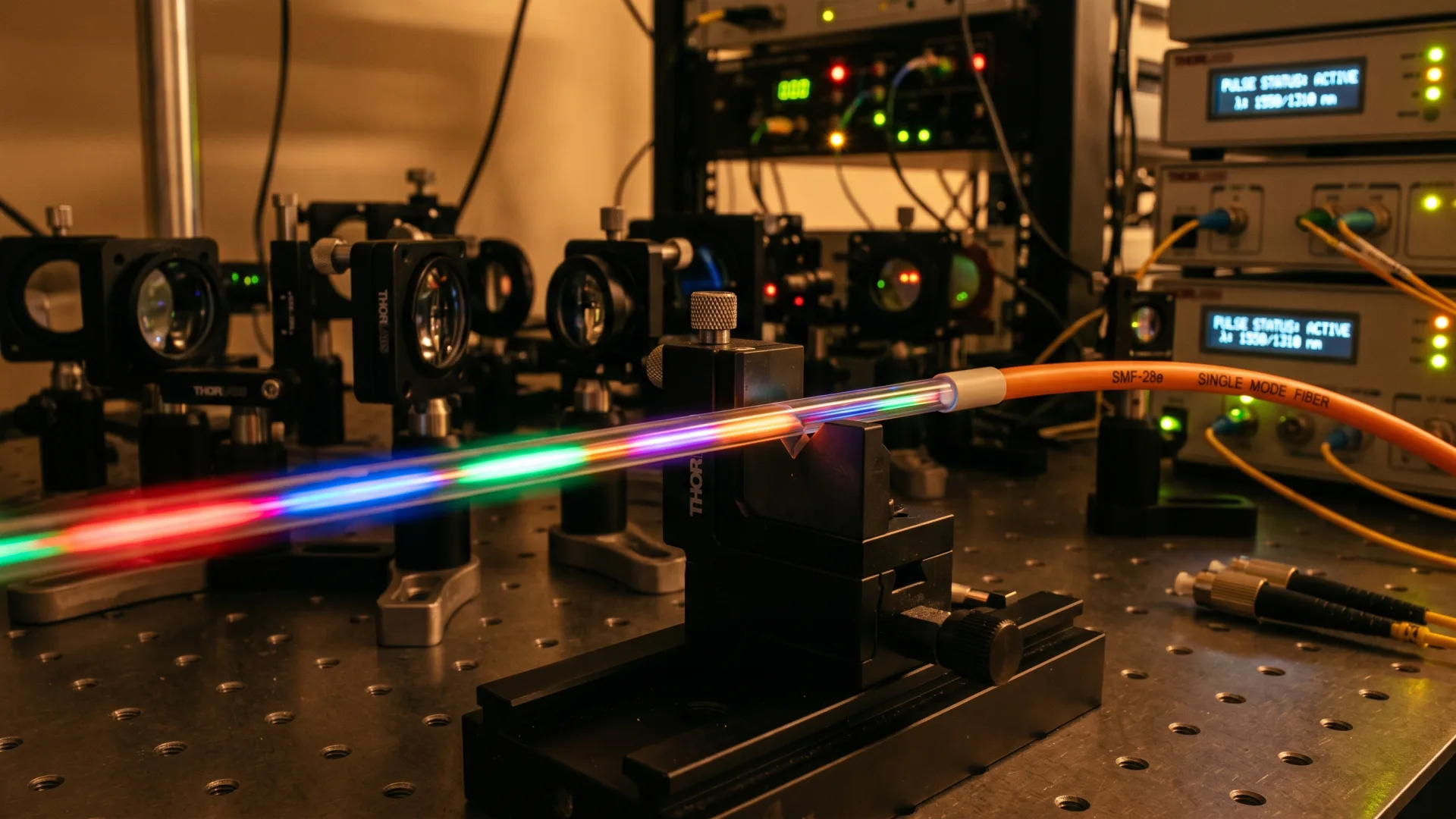
In an age where "high-speed fiber" is plastered across ISP brochures and data center brochures alike, the term risks becoming hollow — a buzzword stripped of its scientific substance. But real high-speed fiber isn't about slapping a "10 Gbps" label on a cable. It's about orchestrating light, matter, and time so that pulses of information arrive intact after racing across continents.
So what actually makes one fiber "high-speed" while another — visually identical — struggles at 10 kilometers? Let's look beyond bandwidth claims and into the physics that truly defines performance. If you'd rather approach speed from a systems-engineering perspective, our companion article on the 11 critical factors that influence fiber-optic internet speed covers the hardware, protocol, and QoS layers.
Isn't All Fiber the Same? Why Would One Support 400G and Another Fail at 10G?
On the surface, all single-mode fibers look alike: 125-micron glass strands with a 9-micron core. But beneath that uniformity lies a carefully engineered refractive index profile, dopant distribution, and geometric precision that determine how faithfully the fiber preserves a signal over distance and data rate.
The difference between a legacy G.652.B fiber and a modern G.652.D or G.654.E isn't cosmetic — it's functional. For example:
- Older fibers may have higher water peak absorption near 1383 nm, blocking the E-band and limiting wavelength options.
- Fibers not optimized for low polarization-mode dispersion (PMD) cause random polarization rotation, scrambling phase-encoded signals in coherent 100G+ systems.
- Slight core ellipticity or cladding irregularities — undetectable to the eye — can increase splice loss or induce mode coupling.
In high-speed systems, every imperfection compounds. A 10G link might tolerate 0.5 ps/√km of PMD; a 400ZR coherent link demands <0.1 ps/√km. So no — fiber isn't just "glass." It's a signal-preserving waveguide, and its design dictates its speed ceiling.
If Light Travels at 200,000 km/s, Why Does "Speed" Depend on the Fiber at All?
Because in communications, "speed" doesn't refer to how fast light moves — it's about how much information you can pack into that light and recover accurately at the other end. And that's limited not by light's velocity, but by how much the fiber distorts the signal along the way.
Two key physical phenomena govern this:
- Attenuation: How much light is lost per kilometer.
- Dispersion: How much the signal spreads in time.
Even with perfect transceivers, if pulses smear into one another (inter-symbol interference) or fade below the noise floor, the data is unrecoverable. So "high-speed" fiber isn't faster — it's cleaner, quieter, and more predictable over long distances.
What Role Does Attenuation Really Play in High-Speed Performance?
Attenuation sets the maximum reach before you need an amplifier or repeater. Modern single-mode fiber achieves ~0.17 dB/km at 1550 nm — the lowest loss window in silica. That means after 100 km, only about 2% of the original optical power remains.
But in high-speed systems, it's not just about raw power — it's about signal-to-noise ratio (SNR). Amplifiers (like EDFAs) add noise. The lower the fiber loss, the higher the SNR, and the more complex modulation formats (e.g., 64-QAM) you can use — directly increasing data capacity.
That's why ultra-low-loss (ULL) fibers — with attenuation as low as 0.14 dB/km — are used in transoceanic cables. Saving 0.03 dB/km over 10,000 km means 300 dB less total loss — enough to support multiple terabits without additional regeneration.
In essence: less loss = more spectral efficiency = higher effective speed. For the full budgeting perspective on what counts as acceptable loss in a deployed link, see what is a good dB loss for fiber optics.
Isn't Dispersion Just a Minor Nuisance? Can't Electronics Fix It?
Dispersion is far more than a nuisance — it's a fundamental barrier that defines the Shannon limit of an optical channel. There are two types that matter most:
- Chromatic Dispersion (CD): Different wavelengths travel at slightly different speeds. In standard SMF, CD is ~17 ps/(nm·km) at 1550 nm. For a 10-Gbps signal (with ~0.1 nm spectral width), this causes manageable pulse spreading. But for a 400G coherent signal using 64-QAM across 75 GHz of bandwidth, CD smears pulses so severely that they overlap — unless compensated.
- Polarization-Mode Dispersion (PMD): Imperfections cause the two polarization states of light to travel at different speeds. In older fibers, PMD could exceed 0.5 ps/√km — catastrophic for 100G+ systems that encode data in both phase and polarization.
While digital signal processing (DSP) in coherent receivers can compensate for deterministic CD, it struggles with random, time-varying PMD — especially in dynamic environments (e.g., aerial cables swaying in wind). Hence, high-speed fiber is manufactured with extreme core circularity and low stress to minimize PMD at the source, not just fix it later.
So no — electronics can't fix everything. The fiber must be part of the solution.
How Do Fiber Designers Actually "Engineer" Dispersion?
Through refractive index profiling during preform fabrication. By controlling the concentration and radial distribution of dopants like germanium or fluorine, engineers sculpt how light propagates.
For example:
- Non-Zero Dispersion-Shifted Fiber (NZ-DSF, ITU-T G.655): Shifts the zero-dispersion wavelength away from 1550 nm (e.g., to 1500 nm) so that a small, controlled amount of dispersion remains. Why? To suppress nonlinear effects like four-wave mixing (FWM) in dense WDM systems — where channels interact if dispersion is too low.
- Large Effective Area Fiber (LEAF): Increases the mode field diameter (e.g., from 80 µm² to 110 µm²), reducing optical power density. This raises the threshold for stimulated Brillouin scattering (SBS) and other nonlinearities — critical for high-power, long-haul transmission.
- Cut-Off Shifted Fiber (G.654.E): Optimized for 1550 nm with ultra-low attenuation and large effective area — ideal for submarine cables where every dB and nonlinear penalty matters.
This isn't guesswork. It's computational photonics meets precision manufacturing, where simulations guide CVD deposition layer by layer. For a deeper look at how raw silica, dopants, and preforms become finished fiber, see low-loss optical fiber from raw materials to final product.
Does "High-Speed" Mean the Same Thing for Data Centers and Submarine Cables?
Not at all. The definition of "high-speed" is application-dependent:
- In data centers, reach is short (<10 km), so the priority is low cost, high density, and low connector loss. OM5 multimode fiber or bend-insensitive SMF (G.657.A1) dominates — speed comes from parallel optics (e.g., 8 fibers for 400G-SR8), not fiber physics.
- In metro networks, fibers balance dispersion, loss, and compatibility with legacy plant — G.652.D is the workhorse.
- In long-haul and submarine systems, every physical parameter is optimized: ultra-low loss, large effective area, minimal PMD, and hydrogen resistance. Here, "high-speed" means maximizing spectral efficiency over 10,000 km, not just raw bit rate.
So the "best" high-speed fiber isn't universal — it's purpose-built. That's why TTI Fiber's outdoor fiber optic cable portfolio covers distinct constructions — GYTA, GYTS, ADSS, armored loose-tube — each matched to a different reach-and-environment regime rather than relying on a one-size-fits-all design.
Can't We Just Use Better Transceivers and Ignore the Fiber?
That's a tempting illusion — and a costly one. Transceivers and fiber are co-dependent. A 800G coherent pluggable can't overcome a legacy fiber with high PMD or E-band water peak. Conversely, the most advanced G.654.E fiber is wasted if paired with a 10G SFP+.
The highest-performing networks treat the fiber-transceiver pair as a single optical channel. System vendors simulate end-to-end performance — including fiber type, span loss, dispersion map, and nonlinear penalties — before deployment.
In short: you can't DSP your way out of bad fiber. The physics must support the electronics. Connector-level optical cleanliness matters just as much — TTI Fiber's fiber optic patch cords ship with 100% end-face inspection and low-IL/high-RL polishes, so the transceiver's launch power actually reaches the fiber it was designed for.
So What Truly Defines "High-Speed" Fiber?
Not bandwidth. Not marketing claims. But fidelity — the ability to deliver a complex optical waveform to its destination with minimal distortion, loss, or noise.
High-speed fiber is:
- Low-loss, to preserve SNR over distance.
- Dispersion-managed, to control pulse spreading without inviting nonlinearities.
- Polarization-stable, to support advanced modulation.
- Geometrically precise, to ensure low splice and connector loss.
- Environmentally robust, to maintain performance for decades.
It's not about how fast light moves — it's about how faithfully it carries meaning.
And in a world where a single fiber pair can carry the equivalent of 10 million simultaneous HD video streams, that fidelity isn't just engineering — it's civilization's silent infrastructure.
So the next time you hear "high-speed fiber," don't think bandwidth. Think physics, precision, and patience — the quiet science that keeps our digital world coherent, one photon at a time. Ready to spec fiber that earns the label? Browse the TTI Fiber product catalog or talk to our engineering team.