What Is Fiber Optic Data Rate
What Is Fiber Optic Data Rate—And Why Is It the Lifeblood of Our Connected World?
Every time you stream a 4K movie, join a global video call, or rely on cloud-based AI, you’re riding on a river of light—pulsing through hair-thin strands of glass at nearly the speed of light. At the heart of this miracle is fiber optic data rate: the measure of how much information optical fiber can carry per second. But what really determines this rate? Why can’t we just keep increasing it infinitely? And how close are we to hitting the physical limits of light itself? Let’s journey through the physics, engineering, and future of one of the most critical metrics in modern communications.
If you’re coming at the speed question from the engineering checklist side, our sibling article on the 11 critical factors that influence fiber-optic internet speed walks through the SMF vs MMF, attenuation, GPON, and transceiver levers. For the service-tier side (what Gbps should I actually buy?), see our guide on the best fiber optic speed for your home or office in 2025.
What Exactly Do We Mean by “Fiber Optic Data Rate”?
At its core, fiber optic data rate refers to the maximum volume of digital information that can be transmitted through an optical fiber per unit of time—typically expressed in bits per second (bps), with common units ranging from Gbps (gigabits per second) to Tbps (terabits per second) and beyond.
But this number isn’t just a speedometer reading. It’s the product of a complex interplay between:
- Modulation format (how data is encoded onto light)
- Spectral efficiency (how tightly data channels are packed in frequency)
- Fiber type and quality (single-mode vs. multi-mode, attenuation, dispersion)
- Transceiver technology (lasers, modulators, detectors)
- Signal processing (forward error correction, digital signal processing)
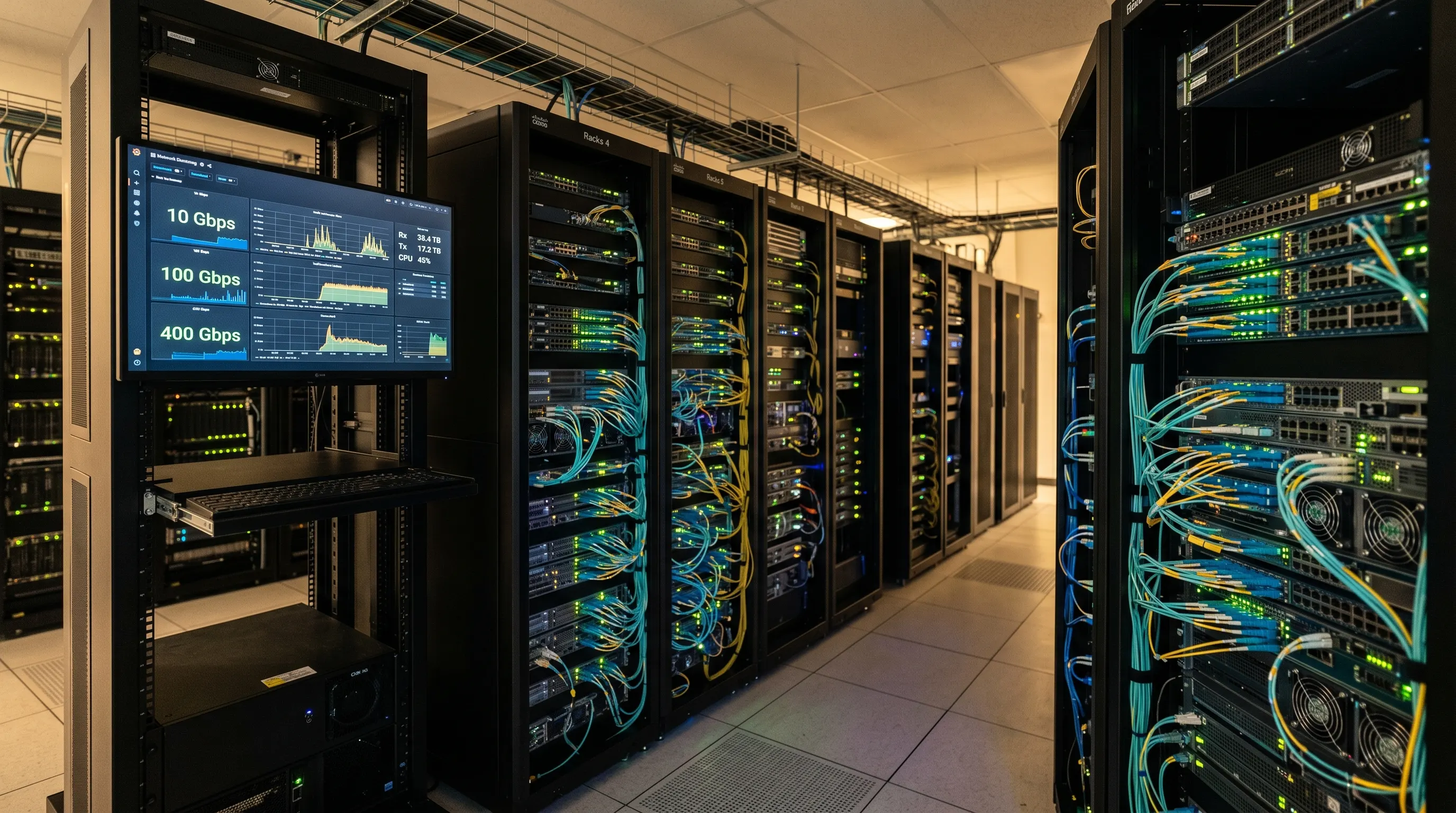
In practice, the “data rate” you see advertised—say, 400 Gbps—is often the aggregate capacity of a system using multiple wavelengths (via WDM), not the speed of a single light channel.
How Is Data Actually Encoded Onto Light—And Why Does It Matter?
Unlike copper wires that carry electrical voltage, optical fiber transmits data by modulating properties of light—intensity, phase, polarization, or wavelength. The sophistication of this modulation directly dictates how many bits each “symbol” can carry.
- On-Off Keying (OOK): The simplest form—light on = 1, off = 0. Used in early systems (e.g., 1–10 Gbps). Spectrally inefficient.
- PAM4 (Pulse Amplitude Modulation, 4-level): Encodes 2 bits per symbol by varying light intensity across four levels. Common in 100G–400G data centers.
- Coherent Modulation (QPSK, 16-QAM, 64-QAM): Simultaneously modulates phase and amplitude of the light wave. A 64-QAM symbol carries 6 bits, enabling terabit-scale transmission. Requires local oscillator lasers and DSP at the receiver.
The trade-off? Higher-order modulation packs more data—but is far more sensitive to noise and fiber impairments. A 64-QAM signal might work over 80 km, while QPSK can span 2,000 km undersea. Thus, data rate is always constrained by reach and signal integrity.
What’s the Real Difference Between Single-Mode and Multi-Mode Fiber—And How Does It Affect Speed?
This isn’t just about core size—it’s about how light propagates:
- Multi-mode fiber (MMF): Core diameter ~50–62.5 µm. Allows hundreds of light paths (modes). But different modes travel at slightly different speeds, causing modal dispersion—pulses spread out, limiting bandwidth-distance product. Max practical data rate: 100 Gbps up to 150 meters (e.g., within a data center rack).
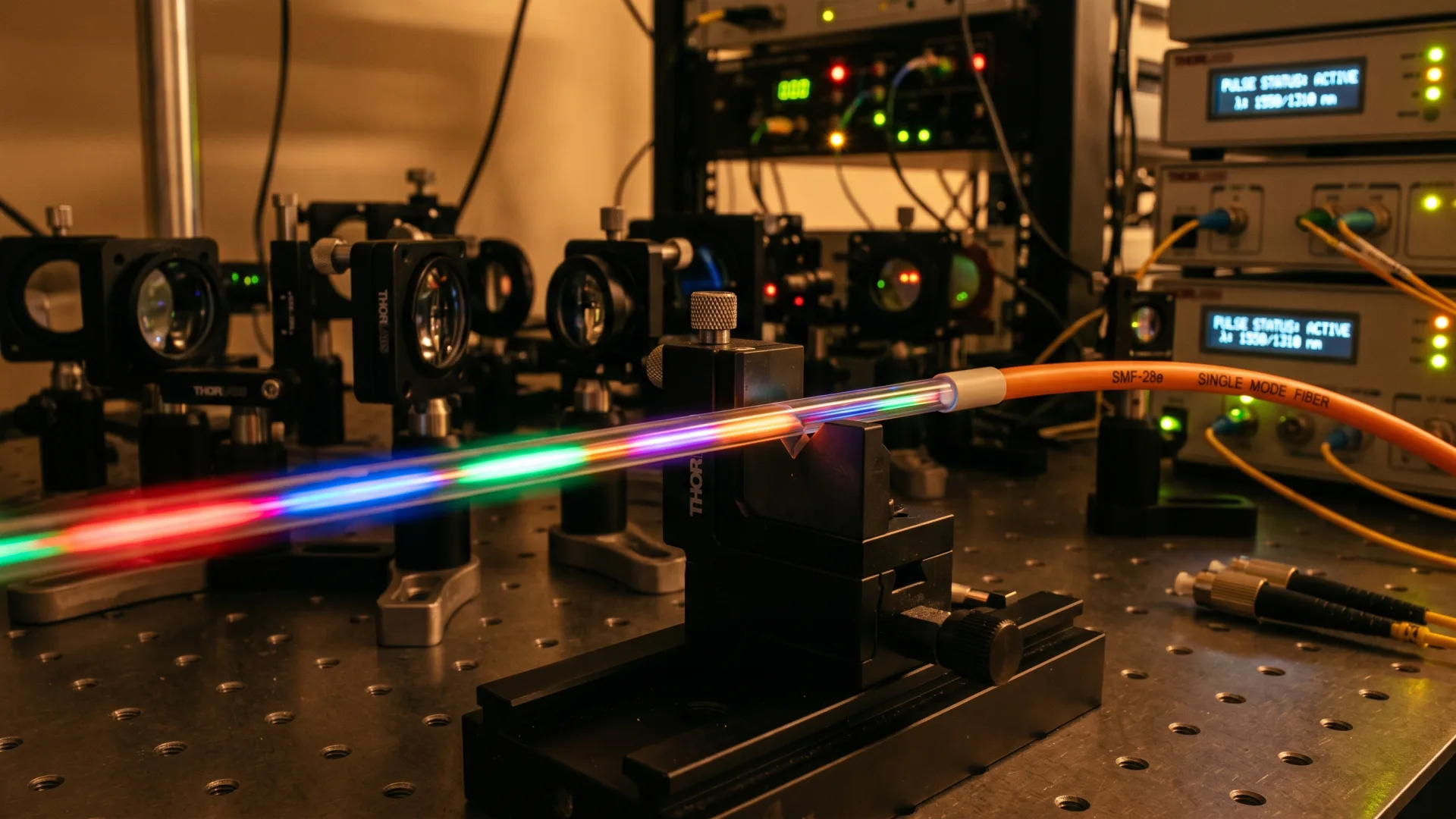
- Single-mode fiber (SMF): Core ~9 µm. Only one fundamental mode propagates. Eliminates modal dispersion, enabling virtually unlimited bandwidth over long distances. This is the backbone of global telecom—carrying 800 Gbps to 1.6 Tbps per wavelength across oceans.
In short: MMF = short-reach, low-cost, moderate speed. SMF = long-haul, high-capacity, future-proof. Choosing the wrong type caps your data rate before you even turn on the laser. For a deeper look at multimode reach specifically, see how far OM4 multimode fiber can transmit.
How Do We Squeeze Terabits Through a Single Strand? Enter Wavelength Division Multiplexing (WDM)
A single laser channel might carry 100 Gbps—but why stop there?
WDM multiplies capacity by sending dozens to hundreds of independent data streams, each on a slightly different wavelength (color) of light, down the same fiber.
- CWDM (Coarse WDM): 18 channels spaced 20 nm apart (1270–1610 nm). Used for metro networks up to 100 Gbps total.
- DWDM (Dense WDM): 80–160+ channels spaced just 0.8 nm (100 GHz) or 0.4 nm (50 GHz) apart in the C-band (1530–1565 nm)—the low-loss window of silica fiber.
Modern submarine cables use C+L band DWDM, doubling usable spectrum. Combined with 800G per wavelength, this yields over 25 Tbps per fiber pair—enough to stream 5 million HD videos simultaneously.
But WDM demands ultra-stable, temperature-controlled lasers and precision optical filters—a triumph of photonic integration.
What Are the Fundamental Physical Limits to Fiber Data Rate?
We’re not just battling engineering—we’re up against laws of physics. Three key limits define the “capacity ceiling”:
- Shannon Limit: The maximum error-free data rate for a given bandwidth and signal-to-noise ratio (SNR). In fiber, SNR is degraded by amplified spontaneous emission (ASE) from optical amplifiers.
- Nonlinear Shannon Limit: At high optical power, Kerr nonlinearities (e.g., self-phase modulation, four-wave mixing) distort signals. This creates a “sweet spot” power level—too low: noise dominates; too high: nonlinearities dominate.
- Bandwidth Limit: Silica fiber has low-loss windows: O, E, S, C, L, U bands (~1260–1675 nm). The C+L bands offer ~9 THz of usable spectrum. Even with perfect modulation, you can’t transmit beyond this.
Current lab records (e.g., 1.84 Pbps over 25 km) use multi-core fiber and multi-mode transmission—but these are not yet practical for field deployment. For standard SMF, experts estimate a practical limit of ~100 Tbps per fiber using existing technology.
Why Can’t We Just Replace All Copper with Fiber Tomorrow?
Because data rate isn’t the only metric that matters. Real-world deployment faces economic and logistical hurdles:
- Transceiver Cost: A 400G coherent pluggable (e.g., QSFP-DD) costs $1,000–$3,000—orders of magnitude more than copper NICs.
- Power Consumption: High-speed optics consume 10–20W per 100G—significant in hyperscale data centers.
- Installation & Splicing: Fiber requires precision cleaving, fusion splicing, and OTDR testing—skilled labor and expensive tools.
- Last-Meter Problem: Fiber-to-the-home (FTTH) is growing, but inside buildings, copper (Cat 6A/8) still dominates for <100m links due to cost and PoE (Power over Ethernet).
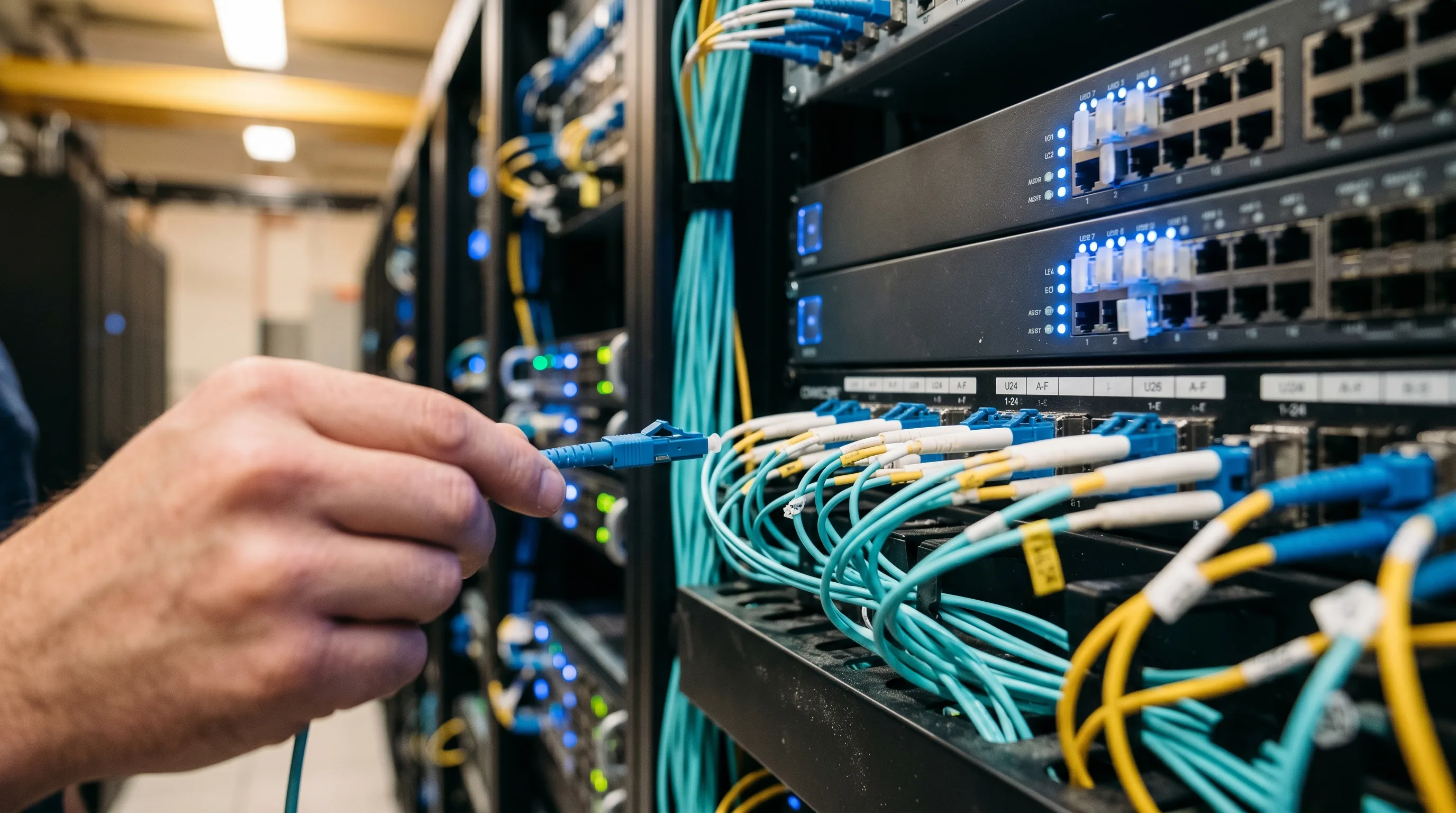
Thus, fiber’s dominance is strategic, not universal: it owns the backbone and data center spine, while copper holds the edge—until optics become cheaper and more integrated. At the rack level, the link from switch to transceiver is almost always a short fiber optic patch cord, whose end-face cleanliness and polish quality directly cap the achievable data rate.
How Do Amplifiers and Regenerators Keep Signals Alive Over Oceans?
Light attenuates—even in ultra-pure glass. Over 100 km, signal power drops by ~99.9%. To span continents, we use:
- EDFAs (Erbium-Doped Fiber Amplifiers): Boost all DWDM channels simultaneously in the C-band without converting to electrical. Simple, reliable, but add noise (ASE).
- Raman Amplification: Uses the fiber itself as the gain medium via stimulated Raman scattering. Lower noise, but requires high pump power.
- Coherent Receivers + DSP: Instead of old-school 3R regenerators (retime, reshape, reamplify), modern systems digitize the analog optical signal and use real-time DSP to undo dispersion, polarization drift, and phase noise.
This shift—from analog regeneration to digital signal restoration—is why we can now transmit 800G over 10,000 km with a single modulation format.
What Role Does Digital Signal Processing (DSP) Play in Pushing Data Rates Higher?
DSP is the unsung hero of modern optical communications. The coherent receiver captures both amplitude and phase of incoming light, converting it to digital I/Q samples. Then, sophisticated algorithms perform:
- Chromatic Dispersion Compensation: Reverses pulse spreading (up to 100,000 ps/nm digitally!)
- Polarization Mode Dispersion (PMD) Tracking: Adapts to random birefringence in fiber
- Carrier Phase Recovery: Corrects laser phase noise
- Nonlinearity Mitigation: Machine learning models predict and cancel Kerr effects
- Forward Error Correction (FEC): Adds redundancy to correct bit errors, effectively lowering the required SNR by 6–10 dB
Without DSP, 400G+ coherent transmission would be impossible. Today’s DSP ASICs consume 20–30% of a transceiver’s power—but they’re the price of terabit-scale optics.
Are We Hitting a Wall—Or Is There Still Room to Grow?
We’re approaching the nonlinear Shannon limit for standard single-mode fiber—but innovation continues on multiple fronts:
- Space-Division Multiplexing (SDM): Using multi-core fiber (7–19 cores) or few-mode fiber to multiply capacity spatially. Lab demos exceed 1 Pbps, but crosstalk and splicing complexity remain barriers.
- New Fiber Designs: Hollow-core fibers (e.g., Nested Antiresonant Nodeless Fiber) reduce nonlinearity and latency by guiding light in air—promising 10× higher capacity and 31% faster speed.
- Photonic Integrated Circuits (PICs): Integrating lasers, modulators, and detectors on silicon or InP chips to reduce cost, size, and power.
- Probabilistic Constellation Shaping (PCS): Dynamically adjusts QAM constellation based on channel conditions, squeezing more bits out of marginal SNR.
The next decade won’t just be about faster per-channel rates—it’ll be about smarter, denser, and more adaptive optical networks.
So—Why Should You Care About Fiber Optic Data Rate?
Because it’s the invisible foundation of the digital age. Every AI model trained in the cloud, every remote surgery guided by real-time imaging, every smart city sensor network—depends on the relentless scaling of optical capacity.
Fiber optic data rate isn’t just a number on a spec sheet. It’s a measure of our collective ability to share knowledge, collaborate across continents, and innovate at scale. And as we push closer to the limits of physics, the engineers designing these systems aren’t just moving bits—they’re expanding the boundaries of what’s possible in a connected world.
In the end, the race isn’t just to transmit more data—it’s to do so more efficiently, sustainably, and accessibly. And that’s a race worth watching.