Applications of OM4 and OM5 Fiber Cables
In today's high-speed digital world, fiber optic cables play a critical role in enabling fast and reliable data transmission. As businesses and data centers evolve to meet growing bandwidth demands, choosing the right fiber optic cable becomes increasingly important. Among the various types of multimode fibers, OM4 and OM5 have emerged as top choices for high-performance networks — and understanding the real-world applications of OM4 and OM5 fiber cables is what separates a future-proof build from an over- or under-specified one.
Below, TTI Fiber walks you through the differences between OM4 and OM5 fiber optic cables, their technical specifications, performance capabilities, and best-use scenarios to help you make an informed decision. For a broader multimode comparison across generations, also see our guide on the difference between OM1, OM2, OM3, and OM4.
What is OM4 Fiber Optic Cable?
OM4 (Optical Multimode 4) fiber optic cables are a type of laser-optimized multimode fiber designed for high-speed data transmission over relatively long distances compared to older multimode standards like OM1, OM2, and OM3.
Technical Specifications of OM4
- Core Size: 50 microns
- Bandwidth: 4700 MHz·km at 850 nm wavelength
- Maximum Distance — 10 Gbps: Up to 550 meters
- Maximum Distance — 40 Gbps / 100 Gbps: Up to 150 meters using parallel optics or WDM technology
OM4 cables offer excellent performance for applications requiring high bandwidth and longer reach within multimode limitations. They are widely used in data centers, enterprise networks, and other environments where speeds up to 100 Gbps are needed.
How OM4 Works
OM4 fiber is optimized for use with vertical-cavity surface-emitting lasers (VCSELs), which are commonly used in short-wavelength, high-speed optical communication systems. The 50-micron core allows for better signal integrity and reduced modal dispersion, enabling higher bandwidth and longer transmission distances than earlier generations of multimode fiber.
Advantages of OM4
- High Bandwidth: With a bandwidth of 4700 MHz·km, OM4 supports demanding applications such as cloud computing, high-performance computing (HPC), and large-scale data center operations.
- Longer Reach: Supports up to 550 meters at 10 Gbps, making it ideal for campus backbones and medium-range infrastructure.
- Cost-Effective for High Speeds: Compared to single-mode fiber, OM4 offers a more cost-effective solution for high-speed connectivity within its distance limits.
Limitations of OM4
- Distance Constraints: At higher speeds like 40 Gbps and 100 Gbps, OM4 can only support up to 150 meters without additional hardware.
- Limited Future-Proofing: While suitable for current high-speed needs, OM4 may not be sufficient for next-generation network requirements beyond 100 Gbps.
For a practical look at OM4's reach limits in production networks, see our deep dive on how far OM4 multimode fiber can transmit at 10G, 40G, and 100G.
What is OM5 Fiber Optic Cable?
OM5 (Optical Multimode 5) fiber optic cables represent the latest generation of multimode fiber, building on the strengths of OM4 while introducing enhanced capabilities for even greater bandwidth and flexibility.
Technical Specifications of OM5
- Core Size: 50 microns (same as OM4)
- Bandwidth: Minimum 4700 MHz·km at 850 nm wavelength, with expanded capability across multiple wavelengths (850–953 nm)
- Wavelength Support: Designed to support Shortwave Wavelength Division Multiplexing (SWDM), allowing multiple signals to be transmitted simultaneously over a single fiber strand.
- Maximum Distance — 10 Gbps: Up to 550 meters
- Maximum Distance — 40 Gbps / 100 Gbps: Up to 150 meters using SWDM or parallel optics
OM5 was developed to address the increasing demand for higher data rates while minimizing the need for additional fiber strands through wavelength multiplexing technologies — a design choice that is especially valuable in hyperscale and next-generation data centers.
How OM5 Works
Like OM4, OM5 uses a 50-micron core optimized for VCSELs. However, OM5 expands the usable wavelength range from a narrow band around 850 nm to a broader spectrum (850–953 nm). This wider wavelength support enables Shortwave Wavelength Division Multiplexing (SWDM), where multiple data streams are transmitted simultaneously over different wavelengths through a single fiber pair. This significantly increases overall bandwidth capacity without increasing the number of fiber strands required — which is also why OM5 is commonly specified for Wide-Band Multimode Fiber (WBMMF) applications such as 100G-SR4 and 400G-SR8 breakout links.
Advantages of OM5
- Higher Flexibility: With support for multiple wavelengths, OM5 provides greater scalability for future high-speed applications.
- Efficient Use of Fiber: By enabling SWDM, OM5 reduces the number of fiber strands required for high-speed connections, lowering infrastructure costs.
- Future-Proofing: OM5 is designed to support emerging technologies and data rates beyond 100 Gbps, offering a longer lifecycle for network infrastructure investments.
Limitations of OM5
- Higher Cost: OM5 is more expensive than OM4 due to its advanced capabilities and broader wavelength support.
- Compatibility Requirements: To fully utilize OM5's benefits (e.g., SWDM), compatible transceivers and networking equipment are required.
OM4 vs. OM5 — Key Differences
While both OM4 and OM5 fibers share the same 50-micron core size and similar physical characteristics, there are several key differences that set them apart:
| Feature | OM4 | OM5 |
|---|---|---|
| Core Size | 50 microns | 50 microns |
| Bandwidth | 4700 MHz·km at 850 nm | 4700+ MHz·km across 850–953 nm |
| Wavelength Range | Narrow (primarily 850 nm) | Broad (850–953 nm) |
| Support for WDM | No | Yes (supports SWDM) |
| Distance at 10 Gbps | Up to 550 meters | Up to 550 meters |
| Distance at 100 Gbps | Up to 150 meters | Up to 150 meters (with SWDM) |
| Use Cases | High-speed LANs, data centers, campus backbones | Future-ready networks, SWDM applications, scalable infrastructures |
Applications of OM4 and OM5 Fiber Cables
OM4 Applications
- Data Centers: Ideal for high-density server racks and backbone connections supporting 10 Gbps to 100 Gbps speeds.
- Enterprise Networks: Used for internal high-speed communications within large organizations.
- Campus Backbones: Suitable for connecting buildings or facilities within a campus environment.
- Cloud Infrastructure: Supports fast data transfer between servers and storage units in cloud computing environments.
OM5 Applications
- SWDM Deployments: Enables efficient multi-wavelength transmission in next-generation data centers.
- High-Density Environments: Reduces fiber count in high-bandwidth areas by leveraging wavelength multiplexing.
- Future-Ready Infrastructures: Best suited for organizations planning for future upgrades beyond 100 Gbps.
- Telecom Providers: Helps reduce cabling complexity in access networks and metro area deployments.
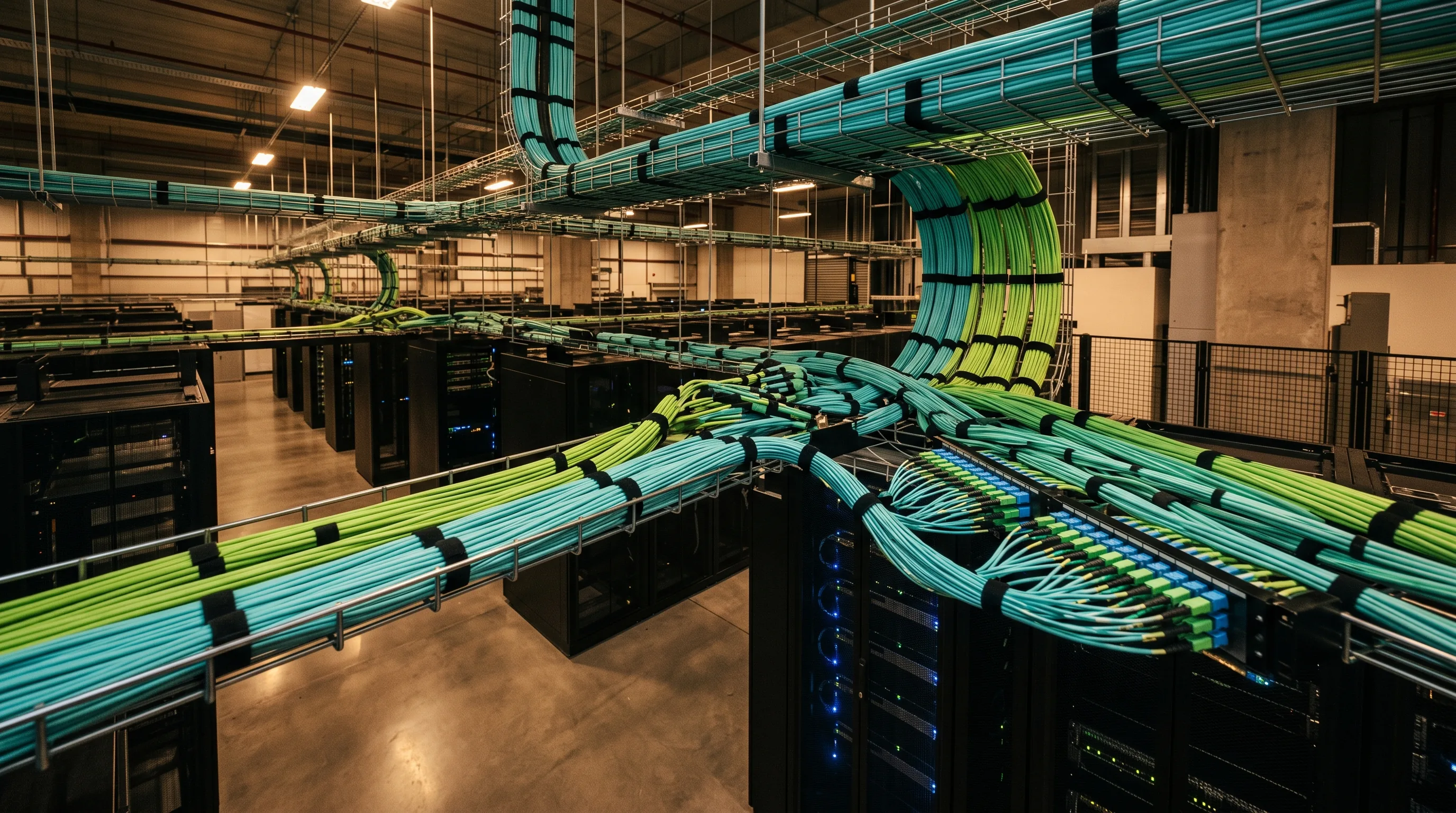
In both OM4 and OM5 data-center deployments, the fiber is typically terminated into high-density MPO/MTP trunk cables and breakouts to feed 40G/100G/400G switch ports with the fewest possible fiber strands.
Choosing Between OM4 and OM5 Fiber Cables
When deciding between OM4 and OM5, consider the following factors:
1. Current and Future Data Rate Requirements
- If your network currently operates at 10 Gbps to 100 Gbps and doesn't plan to scale beyond that soon, OM4 is a cost-effective and reliable choice.
- For organizations anticipating future upgrades to 200 Gbps or higher, OM5 offers better scalability through SWDM capabilities.
2. Infrastructure Complexity
- OM4 requires more fiber strands to achieve higher data rates, which can increase cabling density and management challenges.
- OM5 simplifies cabling with fewer strands needed, especially when using SWDM to combine multiple signals.
3. Budget Considerations
- OM4 is generally less expensive and widely available, making it ideal for budget-conscious deployments.
- OM5 comes at a premium but offers long-term value through enhanced flexibility and future-proofing.
4. Equipment Compatibility
- Ensure your networking gear (transceivers, switches, etc.) supports the fiber type and, in the case of OM5, SWDM technology.
Both OM4 and OM5 fiber optic cables are excellent choices for high-speed, high-bandwidth applications. OM4 remains a strong option for most current high-speed network needs, providing a balance of performance and cost-effectiveness. On the other hand, OM5 introduces innovative features like shortwave wavelength division multiplexing, making it a forward-looking solution for organizations preparing for the next wave of network evolution.
Whether you're upgrading an existing infrastructure or designing a new network, understanding the differences between OM4 and OM5 will help ensure you choose the right fiber optic cable to meet your present and future connectivity goals. If you are still weighing core sizes and are unsure whether 50/125 OM4/OM5 is the right fit at all, our companion article on 50/125 vs 62.5/125 fiber compares the two multimode core sizes head-to-head.